Tuesday, 11 September 2012

Week 8- Annie with Attitude, Creative Fun with Cardboard Tubes & Where's God


Hi guys, Julia here,

This week I’ve done quite a bit of reading! Just worked out that this is due soon and I still need to read another 4 picture books and 2 novels.

I started by reading Annie with Attitude by Margaret Clark. The author has written this book for a teenage audience (those who are going through the blues of puberty). Basically it is about a mother and daughter who have broken away from their crazy father and husband. However instead of supporting her daughter, Annie’s mum seems to be more interested in finding a new boyfriend. Annie is left to face her struggled past memories and the struggles of living a teenage life by herself.

The text is written in first person and it really makes the story seem personal that way. The author allows the main character Annie to use lots of adjectives and really expresses her feelings well. The book is fast moving and it therefore keeps the readers interested. Overall it is a great book that expresses that all teens go through puberty and may have problems amongst friendships and family.

Next I decided to look at a craft book called Creative Fun with Cardboard Tubes by Nikki Connor. It was an interesting book that had procedures all the way through it. A good teacher resource when teaching procedures to students! Each craft task obviously included a cardboard tube. There were step-by-step instructions on how to do the tasks with pictures to support them. Even the materials needed were shown with pictures. Showing visuals makes the book appealing to young children. The methods were simple and if anything was difficult it was clearly stated that an adult would need to help. However, the children themselves could construct most of the activities and this for many is extremely satisfying. The final product was also clearly shown in a photograph format. This book is a picture book that is something different and I’m glad I got the opportunity to look at it.

Lastly I read the text Where’s God? by Victor Kelleher and Elise Hurst. This book is one of the best picture books I’ve read. It is so powerful and explains one of the biggest questions a child has in the most beautiful way. In fact, I love this book so much that I am reading it to my students in Par 2 class as part of their Religion Unit I am teaching them! It is also a great way to explain to teachers the big issue of where is God? Especially those who need to teach Religion but know not a lot about God and his practices. The book is simply written and supported with great images. It is absolutely fantastic and I highly recommended you get your hands on it and have a read!

Wednesday, 5 September 2012

Laura - The Gizmo, Clancy the Courageous Cow and Maebelle's Hat

Hey Guys,
Here is my post for this week!


THE GIZMO

The novel called the Gizmo by Paul Jenings is about a young boy who is pressured into stealing something from the local fair. He steals the Gizmo from a stall and brings it to show his friend, Floggit. The Gizmo turns out to be magical because the boy cannot return it or throw it away, because every time he tries it magically comes back to him. Also, when the Gizmo is turned on, it swaps his clothing to the person nearest to him. After swapping clothing with various characters he finally ends up near Floggit, who then steals the Gizmo from him. As a result, he gets Floggits clothes and the Gizmo now belongs to Floggit. The boy decides that he will return the clothes back to Floggit the next day because he does not want to be a thief.

The language in this book is designed for older or more advanced readers. It is very descriptive and detailed. Deep literacy is used in this novel to describe emotions and experiences. For example, in The Gizmo, the main character describes what he is feeling by relating it to an object.
‘I feel like a worm. A worm of toothpaste that has been squeezed out of the tube and can’t get back in’
Paul Jennings purposely uses this type of descriptive language so it cam be visualised and understood better by the reader.

The main theme of ‘The Gizmo’ is the quest. In this story, the main character’s quest is to somehow get rid of the Gizmo that always finds its way back to him.  This story also has humour intertwined with the main characters thoughts and the situations he is put in, but as it is not associated directly with the story line, it cannot be considered a main theme.

CLANCY THE COURAGEOUS COW

‘Clancy the Courageous Cow’ by Lachie Hume is a picture book about a cow that felt alone because he looked different from the other cows. They treated him differently and he felt like he would never fit in. the story is about how he uses his differences to his advantage and overcomes what other were saying about him. He finds another cow that is different in another way and they bond and become best friends.

This book teaches that being different is not a bad thing and that we need to accept who we are. The text is very descriptive and is linked to the images quite thoroughly, but the images completely rely on the text to tell the story. Many descriptive words are used to compliment the storyline also.
 
The story line for ‘Clancy the Courageous Cow’ has the common introduction, complication and resolution structure and there is a happy ending where everything works out at the end.

MAEBELLE’S HAT

‘Maebelle’s Hat’ by Rita Hestand is set in a farmyard with farm animals as the characters. The title and the front cover are deceiving because just by looking at the front cover you think that Maebelle is he main character and the story is about her hat. Instead, the main character is a duck called Willy and the story is about a large storm moving towards the farm. Maebelle is on a field unaware of the storm and admiring her hat, and Willy goes out to search for her.

The text and the images are both needed to understand the story. The text doesn’t offer many detailed descriptions of the characters or scenes, so in order to understand the story fully you must read the text alongside the images. For example, the main character, Willy, is a yellow duck. The text at no stage described Willy as a yellow duck. Without the pictures to guide you, you can assume Willy is almost anything. The images complete the telling of the story.


See you guys next time!
Laura


Tuesday, 4 September 2012

Week 7- Workshop Summary

Hi guys, Julia again,

I'm writing up the weekly workshop notes this week. Basically I am going to recap what we talked about in the provided discussion time. Firstly we identified that all the readings were about different reading styles. After acknowledging this we went on to talk about guided reading. What we didn’t know was that this is done with a group of students of the same abilities. They are sat down and given a book that is slightly harder than their normal reading levels and they read this. We learnt in class that the text book confuses the topic a bit but Carol fixed up these misconceptions with a great video clip (which I’m sure you all remember). With the topic of guided reading we also talked about how we had seen some examples in our placement and how reading groups were put in place to establish different student abilities.

We then went on to talk about how we could personally tell if a child reads in their spare time by just talking to them. We all agreed that children who read often seem more confident in the way they speak and hold conversations and they often find talking to groups of people a lot easier.

Next we jumped to talking about how students need to read to understand. Learning how to read isn’t just being able to speak the words but to also understand what is going on in the book. Basically we said that some students read books a few times before they absorb them and this as a teacher is important to note. On placement my class has a reading strategy called connections. It is a good way to help with reading comprehension. Basically before students read their books they needed to guess what might happen in them and then after they had read their books they needed to make connections with the setting, characters and plot. This reading is done with pairs with their teacher or support teacher.

We also talked about independent reading and how students need to be reading at a lower level when doing this. This is because they are obviously getting no support and therefore if the book is easier they have more chance of understanding it and feeling confident reading it. It is important that students feel confident and with this we talked about how teaching certain books can be hard for a teacher. This is because different students like different texts and this means that there needs to be a diverse range of readers in the classroom.

That was a long re-cap but we did do some serious talking! See you next week :)

Week 7- Fishy Facts & The Angle and the Soldier Boy

Hi there, Julia here,

This week I've read two very interesting picture books!

The first is a non-fiction book about fish. It's called Fishy Facts by Ivan Chermayeff. Basically it is a very simple written text that gives all sorts of interesting facts about fish. The sentences are short and the content is very easy to understand. The interesting information is supported with great pictures which makes it appealing to young children! The pictures have bold colours and draw the attention of readers. Students after reading a book like this could present their findings in an information report. The book is written in a way that is does not have to be read in a linear manner. It is similar to the books we looked at in class but a lot more simple.

The second book I read was The Angel and the Soldier Boy by Peter Collington. This book had absolutely NO writing but yet a child could still understand it! Basically the entire story is told via pictures and can be interpreted in many ways! The basic story line is evident in the book (a child goes to sleep with of her 2 toys and they undertake an exciting adventure while she is sleeping) but the details are left to the reader’s imagination… It is a good book because the reader has to use their imagination and it is also easy to reader because it has no words. It can build a child’s confidence in being introduced to books and all their functionalities.

These two pictures book are definitely worth a read! I particularly liked the book without writing because it gave even myself the opportunity to use my imagination (something young children find very easy!).

Sunday, 2 September 2012

Week 6 Post

Hey its Jordan here,

I know this is a bit late but I was unable to do this last week. For the past two weeks I have been reading Now by Morris Gleitzman and Willy the Whale by W.L Cripps.

Now is the second to last book in Gleitzmans World War II series. In this book Felix is happily living with his granddaughter Zelda until a natural disaster strikes Felix's home, forcing both grandfather and granddaughter into confronting their demons, their fears and some home truths. Throughout the book there relationship grows even more, as Zelda tries to help Felix come to terms with what he lost in the 1940s. This book was really interesting as it deals with real life issues such as bullying and trauma experienced by war.
Willy the Whale is a story about a whale who gets caught in a net and is trying to get free. Whilst in the net a tuna and a shark swim past and refuse to help him. Eventually the net is raised and Willy see's a fisherman. However, the fisherman helps him and in the end catches the shark and tuna. This book teaches kids about being nice to your family and friends and that if you do nice things for someone, it will comeback to you in the end. One part of this book that I found interesting was the rhyming pattern. The second line on each page rhymed with the last word on the same page. I found this interesting and it made the book easier to read.


Saturday, 1 September 2012

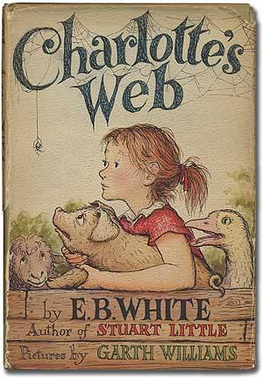
Week 7 - Charlotte's Web

 
Hello there!

Ryan here again and this week I read a classic novel that was used with my year 8 English class called Charlotte's Web written by E.B White. The story depicts a pig named Wilbur and his spider friend called Charlotte who saves him from being slaughtered. Wilbur was a pet for the farmers daughter, Fern, due to it being the runt of the litter and her begging her father not to kill him. After being spared, Wilbur gets sold to Fern's uncle and although Fern sometimes visits him, her visits decrease as she becomes older, making Wilbur lonelier each day. Eventually he meets Charlotte, the grey spider who welcomes him into the community of animals living on the farm.
The students who read this story experience a higher reading level and understanding of the story being presented. They are able to connect to these new themes and plot points, especially the compassion of Charlotte and the friendship her and Wilbur possess. They are able to reflect on concepts such as the spiders life cycle as well as that of pigs and their births.

The way this story is written shows great depth and description in terms of the way E.B White portrays situations. A specific example of this would be the description of swinging on a rope swing at the form, having a certain rhythm and feeling specific to this book. The pace of sentences of this part mimics the motion of the swing. This aspect could be shown to students and allow them to understand this in terms of literacy and the meaning this writing style reflects on the rest of the story. 

The next book I'll be reading will be The Waterhole by Graeme Base.

Until next time.

Week 6 - Workshop summary

Hello there, Ryan here,

This week in the workshop we discussed what is reading and how do students know how to read. This falls under the categories of:
  • How to handle books
  • A sense of story
  • Locating known words and basing the understanding of a sentance on these words.
  • Finding meaning in the sentances and their structure.
  • Learning how to self correct and utilizing this in their understanding of sentance structure.
These points were discussed by peers and reflected on, espeecially with the video called Learn to read with India. This showed a young girl reading a story and specified on her self corrections and error of certain words. WHile watching this video, certain aspects discussed in previous workshops were able to be reinforced and demonstrated in a practical sense.

There was also discussion of the book Brown Bear, Brown Bear, what do you see? and how it could be utilized in a primary schooling enviroment.